WoW Gold Farms
 The Burning Crusade · Economy and Vendors
How to Make Gold in The Burning Crusade: A Data-Based Starting Plan
A plain plan for making gold in Outland, built from our 2.4.3 world data: which zones and instances pay, which materials to gather, and what we cannot tell you.
We hold no live Auction House data for The Burning Crusade, so this strip lists each item's vendor sell value from our world database and no market price.
The short answer
In The Burning Crusade, gold comes from four places: the cloth, leather and motes that Outland mobs carry, the coin and items from dungeon trash, the crafting recipes that turn those raw goods into bags and primals, and the market that sits above them. Our data covers the first three completely and the fourth not at all. We hold no Auction House prices for this version, so every number on this page is a drop chance, a spawn count, a recipe count or a vendor sell value. That is enough to choose where to go. It is not enough to promise a profit, and we will not pretend otherwise.
- Level
- 60 to 70
- Profession
- Skinning, Mining or Herbalism help, none required
- Group
- Solo for field farms, five players for instances
- Mount
- Flying at 70
Step one: pick the zone from the value table
The table below ranks the Outland field zones by the average value of one kill: the coin dropped plus the vendor value of the expected loot. It covers normal-rank creatures of level 58 and up.
| Zone | Mob types | Spawns | Coin per kill | Item vendor value per kill | Together |
|---|---|---|---|---|---|
| Nagrand | 184 | 2402 | 93 copper | 12 silver17 copper | 13 silver10 copper |
| Zangarmarsh | 164 | 2524 | 56 copper | 12 silver49 copper | 13 silver5 copper |
| Terokkar Forest | 406 | 2919 | 1 silver44 copper | 10 silver74 copper | 12 silver18 copper |
| Netherstorm | 274 | 2706 | 1 silver16 copper | 10 silver37 copper | 11 silver53 copper |
| Shadowmoon Valley | 282 | 3456 | 1 silver66 copper | 9 silver68 copper | 11 silver35 copper |
| Blade's Edge Mountains | 288 | 2551 | 97 copper | 10 silver20 copper | 11 silver17 copper |
| Hellfire Peninsula | 271 | 2975 | 85 copper | 8 silver66 copper | 9 silver51 copper |
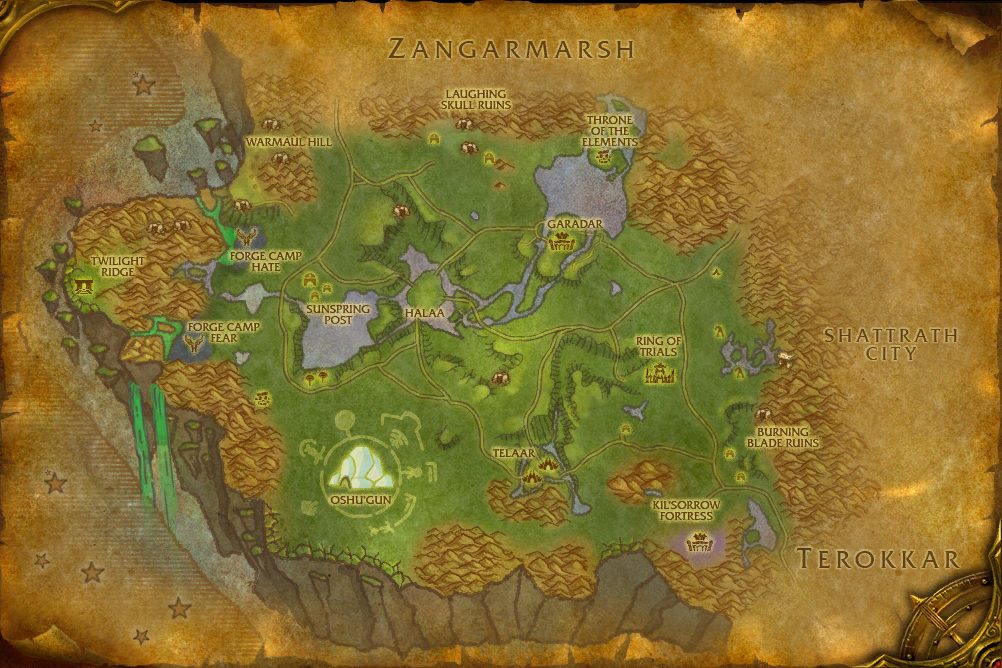
Nagrand comes first at 13 silver10 copper a kill, with Zangarmarsh a hair behind at 13 silver5 copper. Hellfire Peninsula is last at 9 silver51 copper, which matters because it is the first zone every character visits. The advice that follows is simple: level through Hellfire, and farm in Nagrand or Zangarmarsh. The two share the same trait, which is a large number of animals and humanoids that carry cloth, leather and low-value loot that sums to a respectable total.
Step two: add the instances if you have a group
Dungeon trash is worth far more per kill. The best five-man instance in our table, Shadow Labyrinth, averages 71 silver69 copper a kill, and even the weakest on the list, the Escape from Durnholde, is 33 silver67 copper. The full ranking, with spawn counts and the split between coin and items, is in the dungeon trash guide linked below. The headline is that an instance is worth three to five field kills per kill, at the cost of needing a group.
Step three: know the four raw goods
These are the items that carry the economy of the expansion, and our data tells you where each comes from.
- Netherweave Cloth drops from many humanoids and a few animals across Outland. A piece vendors for 8 silver. The cloth guide lists the zones and the single mobs with the best chance.
- Knothide Leather comes from skinning, mainly the talbuks of Nagrand, at up to eighty percent a skin. It vendors for 12 silver50 copper. The rarer Fel Hide vendors for 62 silver50 copper.
- Motes drop from elementals, wraiths and voidspawn, and ten make a primal. A mote vendors for 4 silver and a primal for 40 silver.
- Primal Nether drops only from the final bosses of heroic dungeons, at five percent, and vendors for 1 gold60 silver.


Step four: use recipes to see what raw goods are worth as inputs
Our client extract shows how much raw material the common recipes eat. A Bolt of Netherweave is six cloth. A Netherweave Bag is four bolts plus one Rune Thread, or twenty four cloth. A Bolt of Imbued Netherweave is three bolts plus two Arcane Dust. Alchemists transmute primals one for one, so Air, Water, Fire and Mana primals are interchangeable at the cost of one transmute each. Smelting Adamantite Bar takes two Adamantite Ore. Those counts tell you the input bill of every product, which you can compare against your own server's prices in two minutes.
What a plan looks like
- Levels 58 to 62: quest through Hellfire Peninsula. Loot cloth, vendor the rest.
- Levels 62 to 67: move to Zangarmarsh and Nagrand. Skin the talbuks, loot the cloth, keep the motes.
- Levels 67 to 70: Shadowmoon Valley and Netherstorm, with dungeons as groups become available.
- Level 70: choose between a farm and an instance based on whether you have a group, and time yourself on one run before deciding.
Outland starter gold plan
Not walked yet
No hourly gold figure is published here until this route has been walked end to end with a timer and a full loot log. Until then this page gives you the inputs (live prices and what drops) and leaves the arithmetic to you.
What we cannot tell you
We have no Auction House data for this version, so we cannot say what a stack of cloth, leather or motes sells for, which recipes have the best margin, or which farm has the best hourly return. We have not timed any route. Our values come from the world database for patch 2.4.3, so a different server build may differ. A guide that gives you those numbers without a source has invented them.
Common mistakes
- Farming Hellfire Peninsula after level 62. It has the lowest value per kill of any field zone.
- Assuming a primal is worth more than ten motes. At a vendor they are equal.
- Skinning every corpse. Our data shows chances below fifty percent on average.
- Running instances for trash alone without a group that moves quickly. The overhead can cancel the value.
Where to go next
The Netherweave guide lists every zone that drops cloth. The Knothide guide ranks the beasts to skin. The mote guide explains the ten to one rule and Primal Nether. The dungeon trash guide gives the full instance ranking. Read them in that order if you are new to Outland, and treat each one as a table to be checked against your own server rather than as a promise.
The vendor ladder
Because we cannot see the market, the cleanest thing we can build is a ladder of vendor values, from the cheapest item to the dearest. Knothide Leather Scraps sit at the bottom at 2 silver50 copper. Motes follow at 4 silver, then cloth at 8 silver, then leather and Fel Scales at 12 silver50 copper. Above them come Adamantite Ore at 15 silver, Khorium Ore at 25 silver and primals at 40 silver, then Fel Hide at 62 silver50 copper and Primal Nether at 1 gold60 silver. The ladder is a floor for each item: no seller should accept less, and the market may pay more.
The ladder also shows why a stack of ten motes and a single primal are the same at a vendor, and why Fel Hide and Heavy Knothide Leather are the same. Items that tie at the vendor are worth comparing on your own Auction House, because that is where one of them will pull ahead.
Choosing between gathering and killing
Gathering and killing earn from different tables. When you mine a node or pick an herb, you collect the node. When you kill and skin a mob, you collect its corpse loot and then a second roll from its skin. Our data has the second rolls for leather, scales and motes, and it has the corpse loot for cloth and dungeon trash. It does not have node spawns, so we cannot rank mining or herbalism zones, and we will not guess them. If you have a gathering profession, treat it as an addition to a kill route, not a replacement, until you have your own numbers.
A good habit follows from this. Before you leave a zone, compare what you looted against the table for that zone. If you collected far less than the table suggests, you probably skipped the cheap items, and those add up. If you collected far more, you got lucky with a rare drop, and the table will pull you back toward its average over time.
Changelog
- 2026-11-25: First version from our world database for patch 2.4.3 and the 2.5.6 client recipe extract.
Related gold guides
 ClothNetherweave Cloth in The Burning Crusade: Where It Drops and What It Is WorthWhere Netherweave Cloth drops in Outland, with drop chances and spawn counts from our 2.4.3 data.
 Skinning and LeatherKnothide Leather in The Burning Crusade: Which Outland Beasts to SkinThe Outland beasts that skin into Knothide Leather and the rarer hides, ranked by zone from our 2.4.3 data.
 Dungeon and Mob FarmsMotes and Primals in The Burning Crusade: Which Elementals Drop ThemWhere each Outland Mote drops, the ten for one primal rule, and why Primal Nether is a dungeon boss drop.Economy and VendorsOutland Dungeon Trash in The Burning Crusade: Which Instances Pay Most Per KillOutland dungeons ranked by coin plus item vendor value per average normal-rank kill, from our 2.4.3 data.
How this guide was written
We hold no live Auction House data for this version, so this page prints vendor values and never a market price. Item names and icons come from our datamine and spawns, vendors and drops from our world database for the patch. We do not publish gold-per-hour numbers for any route nobody has walked and timed, so where a rate would go this page says so. Read the full method or the about page.